
Before you use any of this
The figures here come from published studies and practitioner handbooks. They are reference points, not prescriptions. Reading them does not make you our patient, and none of it replaces your own physician.
Most of these compounds are not FDA-approved. LYV does not sell peptides that are not FDA-approved. What we do is sit down with you, read the evidence together, and work out what makes sense for your history.
Where a compound has no published human research behind it, we say so. That gap is usually the most useful thing on the page.
Peptide 101
How to mix a vial, how to inject it, how to store it, and what all the jargon means.
What Are Peptides?
Peptides are short chains of amino acids — typically 2 to 50 — that act as signaling molecules in your body. A peptide does not force a change the way most drugs do. It tells a receptor to do something the cell already knows how to do: release growth hormone, repair tissue, calm an immune response, change how fat gets used.
Natural
Your body already makes hundreds of them. The therapeutic versions are either identical to what you produce or close analogs of it.
Targeted
They bind to specific receptors rather than acting across the whole system, which is why their side effect profiles tend to be narrow.
Unevenly Studied
A handful have decades of clinical trials and FDA approval behind them. Most have far less than that. The cheat sheet marks which is which.
Reconstitution Step-by-Step
Peptides ship as freeze-dried powder. Reconstitution is the process of adding bacteriostatic water (BAC water) to create an injectable solution. Follow these steps precisely.
Gather Your Supplies
You'll need: peptide vial, bacteriostatic water (BAC water), alcohol swabs, and a U-100 insulin syringe (0.5 mL or 1 mL, 29–31 gauge).
Clean Both Vial Tops
Swab the rubber stopper on both the peptide vial and BAC water vial with an alcohol pad. Let dry completely (15–30 seconds).
Draw BAC Water
Insert the syringe into the BAC water vial. Pull back slowly to your target amount (typically 1–3 mL). Use our Calculator to determine the exact volume.
 Cell Factors requires sterile water, NOT BAC water.
Add Water to Peptide Vial
Insert the needle into the peptide vial at an angle. Let the water slide gently down the inner wall of the vial. Do NOT spray directly onto the powder — this can damage the peptide.
Gently Dissolve
Swirl the vial gently in a circular motion. Never shake. Set it down and let it rest if needed — full dissolution can take 2–5 minutes. The solution should be crystal clear.
Draw Your Dose
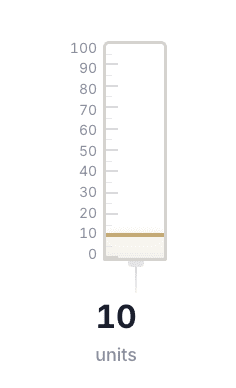
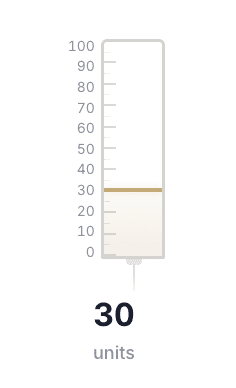
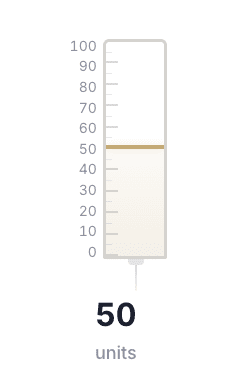
Use a fresh syringe. Insert into the reconstituted vial, invert, and draw to the unit mark shown by the Calculator. Tap the syringe to move air bubbles to the top, then push them out.
Example: 10 units
U-100 Syringe
Example: 30 units
U-100 Syringe
Example: 50 units
U-100 Syringe
Injection Technique
Choose Your Site
Subcutaneous (SubQ) injections are given into the fat layer. Common sites: lower abdomen (2 inches from navel), outer thigh, back of upper arm. Rotate sites with each injection.
Prepare the Area
Clean the injection site with an alcohol swab using a circular motion outward. Let it dry completely — injecting into wet alcohol stings.
Pinch & Insert
Pinch a fold of skin between your thumb and forefinger. Insert the needle at a 45-degree angle (or 90° if using a short needle). One smooth, steady motion.
Inject Slowly
Push the plunger down slowly and steadily. Fast injection = more discomfort. Count to 5 while injecting.
Withdraw & Apply Pressure
Pull the needle out at the same angle you inserted it. Apply gentle pressure with a clean cotton ball or swab. Do not rub.
Abdomen L
2" left of navel
Most common
Abdomen R
2" right of navel
Most common
Thigh L
Outer mid-thigh
Thigh R
Outer mid-thigh
Deltoid L
Upper arm (outer)
Deltoid R
Upper arm (outer)
Glute L
Upper-outer quadrant
Glute R
Upper-outer quadrant
Storage & Safety
✓ Do
• Refrigerate reconstituted peptides (36–46°F / 2–8°C)
• Use within 28 days of reconstitution
• Store unreconstituted vials in cool, dark place
• Always use bacteriostatic water (except Cell Factors)
• Use a fresh syringe for each injection
• Swab vial tops with alcohol before every draw
✗ Don't
• Never freeze reconstituted peptides
• Never shake vials — gently swirl only
• Don't spray water directly onto powder
• Don't use cloudy or discolored solution
• Don't share syringes or multi-dose vials
• Don't expose vials to direct sunlight or heat
Unreconstituted (Dry Powder)
Room temperature or refrigerated. Stable for months to years. Refrigeration extends shelf life significantly.
Reconstituted (Mixed)
Must refrigerate. Use within 28 days. Discard if cloudy or off-color.
Popular Stacks by Goal
Stacking just means running more than one at a time so the effects overlap. These are the combinations that come up most often. None of them have been trialled as combinations, so treat them as a starting point for a conversation, not a protocol. Always consult your provider before starting a stack.
 Fat Loss & Recomposition
Tesamorelin drives visceral fat loss through targeted GH release. CJC/Ipa amplifies the GH pulse for lean muscle preservation. AOD-9604 adds lipolytic support without affecting blood sugar.
 Recovery & Tissue Repair
BPC-157 accelerates gut and connective tissue healing. TB-500 promotes systemic tissue repair and reduces inflammation. GHK-Cu supports collagen synthesis and wound healing.
 Cognitive Enhancement
Semax raises BDNF, which is where most of its cognitive claims come from. Selank takes the edge off anxiety without sedating you. Pinealon is the Russian bioregulator answer to the same problem, on much thinner evidence.
 Immune Resilience
TA-1 modulates adaptive immunity and has decades of clinical data. LL-37 provides antimicrobial defense. KPV offers anti-inflammatory support for gut and systemic use.
 Sleep & Recovery
DSIP promotes deep sleep onset. CJC/Ipa taken before bed amplifies nocturnal GH pulses. Epithalon is used for circadian rhythm, though the evidence there is thin.
 Longevity & Anti-Aging
Epithalon has been reported to raise telomerase activity, mostly in Russian work that has not been widely replicated. GHK-Cu shifts gene expression in skin and connective tissue toward a repair pattern. NAD+ feeds mitochondrial function and DNA repair.
Glossary
BAC Water (Bacteriostatic Water)
Sterile water containing 0.9% benzyl alcohol as a preservative. Used to reconstitute most peptides. The preservative allows multi-dose use over 28 days.
cGMP
Current Good Manufacturing Practice. FDA-enforced quality standards for pharmaceutical manufacturing facilities. Worth asking about for anything you are putting in your body.
COA (Certificate of Analysis)
A document from an independent laboratory verifying the identity, purity, and potency of a peptide batch. Any reputable pharmacy or compounder will hand one over on request. If nobody will, that is your answer.
GHRH (Growth Hormone-Releasing Hormone)
A naturally occurring hormone that signals the pituitary to release growth hormone. Peptides like CJC-1295 and Tesamorelin are GHRH analogs.
GH Secretagogue
A compound that stimulates growth hormone release. Ipamorelin and MK-677 are common secretagogues that work via the ghrelin receptor.
HPLC
High-Performance Liquid Chromatography. An analytical technique used to verify peptide purity. Reported as a percentage on a COA. Below about 98% is worth questioning.
Lyophilized
Freeze-dried. Peptides are lyophilized for stability during shipping and storage. Must be reconstituted before use.
Reconstitution
The process of dissolving lyophilized (freeze-dried) peptide powder in bacteriostatic water to create an injectable solution.
SubQ (Subcutaneous)
An injection method where the needle is inserted into the fat layer just beneath the skin. Everything on the cheat sheet is dosed this way.
U-100 Syringe
An insulin syringe calibrated for 100 units per 1 mL. The standard syringe type used for peptide injections. 1 unit = 0.01 mL.
Still working it out?
None of this is a prescription or a diagnosis. Bring it to a provider who can see your labs and your history before you act on any of it.
Copyright 2026 - Privacy Policy
Peptide Resources